
Registering a company in China is not one single application.
It is a sequence of decisions, registrations and operating arrangements that may involve company establishment, tax, banking, customs, foreign exchange, work permits and ongoing compliance.
The exact process depends on what you plan to do. A consulting company, a sourcing office and an import-export trading company may all require different setups. A foreign founder who wants to live and work in China will also have additional requirements compared with an overseas shareholder who does not work in the country.
This guide explains the complete process and helps you identify which stages may apply to your business.
Quick Answer
QUICK ANSWER
A standard foreign-owned company setup normally involves three core stages:
- Establishing the legal company
- Activating tax, banking and operating functions
- Maintaining accounting, tax and annual compliance
Additional stages may apply when the company:
- Imports or exports goods
- Applies for export tax refunds
- Hires foreign employees
- Supports a foreign founder's work permit
- Operates in a regulated industry
Not every company needs to complete every step. The correct setup should follow your actual business model.
THE COMPLETE ROADMAP
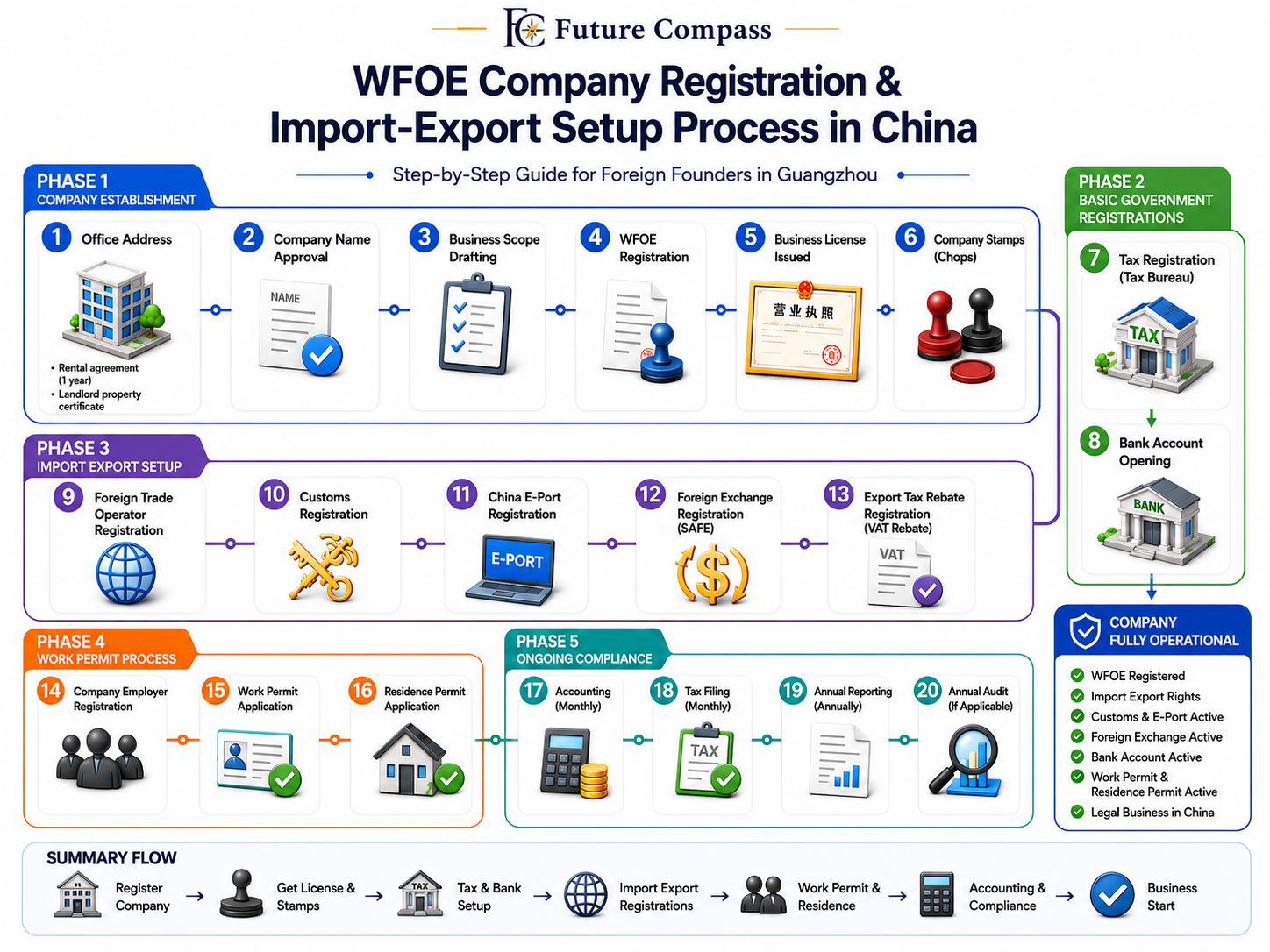
Tap to view full size ↗
The complete process may include company establishment, tax and banking, import-export activation, work permits and ongoing compliance. Not every business requires every phase.
Phase 1: Establish the Company

1Clarify Your Business Model
Before choosing a company name or registered address, first clarify what the company will actually do.
Important questions include:
- Will the company provide consulting or other services?
- Will it buy and sell physical products?
- Will it import or export goods?
- Will it hire employees in China?
- Will a foreign shareholder work in the company?
- Does the business require a special licence?
These answers affect the company's business scope, registered address, tax position and later compliance requirements.
FUTURE COMPASS TIP
Do not choose the company structure based only on the cheapest registration option. A setup that looks inexpensive at the beginning may create larger costs later if the address, business scope or tax arrangement does not support the actual business.
2Select a Compliant Registered Address
A Chinese company must have a registered address that meets the applicable local registration requirements. Depending on the business and location, possible arrangements may include a dedicated office, a serviced or shared office, a compliant registered-address solution, or certain other qualifying premises where locally permitted.
Before signing a lease or paying a deposit, confirm:
- Whether the address can be used for company registration
- Whether it supports the proposed business activity
- What documents the landlord can provide
- Whether the company can receive official correspondence there
- Whether the address may affect banking or future operations
3Confirm the Company Name and Business Scope
The proposed company name must be checked through the relevant registration system. The company's business scope should then describe its planned activities accurately enough to support real operations.
For a trading business, the scope may need to cover the sale of relevant products and import-export activities. For consulting, technology, marketing or other service companies, the wording will be different. Certain regulated activities may require additional approvals or licences.
4Prepare the Shareholder and Registration Documents
The required documents depend on whether the shareholder is an individual, an overseas company, a Hong Kong, Macao or Taiwan investor, or a combination of investors. Documents issued outside China may require notarisation, an Apostille or another form of authentication, depending on the issuing country and document type. Chinese translations may also be required.
This document-preparation stage is often where international founders lose the most time, especially when the ownership structure has not been decided clearly.
5Submit the Company Registration
Once the company structure, name, address, business scope and documents are ready, the application can be submitted to the relevant market-registration authority. After approval, the company receives its business licence.
The business licence establishes the legal entity, but it does not mean that every operating function is already active. China also recognises electronic business licences, which have the same legal effect as paper licences.
6Arrange the Company Stamps
After the business licence is issued, the company normally arranges its official stamps (company chops). Depending on the company's requirements, these may include:
- Official company chop
- Financial chop
- Legal representative chop
- Invoice chop
- Contract chop
Company chops play an important role in signing documents, banking and daily business operations. They should be stored and controlled carefully.
Phase 2: Activate Tax and Banking
7Complete Tax Onboarding
The company must establish its tax and accounting arrangements. This may include:
- Confirming the responsible tax authority
- Setting up electronic tax access
- Confirming taxpayer status
- Establishing accounting books
- Registering relevant personnel
- Confirming tax-filing requirements
- Arranging invoice-related functions where needed
The tax setup should reflect the company's real activities. A service company with limited transactions may have a very different accounting workload from a trading business with large invoice volumes, foreign-currency receipts and export tax refund claims.
8Open the Corporate Bank Account
The bank will conduct its own customer due diligence before opening the account. Banks may review:
- The company's business model
- Shareholder and legal representative information
- Registered address
- Source of funds
- Expected transaction activity
- Suppliers and customers
- Contracts or business evidence
- Reasons for opening the account
Bank approval is independent from company registration. A business licence does not automatically guarantee that a bank account will be opened. Future Compass can assist with preparation and coordination, but the bank makes the final decision.
Phase 3: Activate Import-Export Operations

This phase only applies when the company will conduct import-export business through its Chinese entity.
9Confirm Import-Export Readiness
China abolished the separate foreign-trade-operator filing requirement at the end of 2022. Companies no longer complete the old Foreign Trade Operator Registration as an independent step. However, a company still needs the correct business scope and must complete the relevant customs, electronic-port, banking, foreign-exchange and tax arrangements before operating its own import-export activities.
10Complete Customs Filing
Companies declaring imports or exports in their own name generally need to complete customs filing as a consignee or consignor of imported or exported goods. The filing may be completed online, including through integrated business-registration systems, the China International Trade Single Window or the customs online platform.
The official customs service guide states that qualifying applications can be submitted online, that the filing itself is not subject to a government fee and that the stated processing period is three working days when the filing requirements are met. Actual preparation time may be longer if company information or supporting arrangements are incomplete.
11Set Up China E-Port Access
China E-Port and related digital systems support customs declarations and import-export data processing. Depending on the company's operating model, setup may involve:
- Enterprise identity verification
- Electronic access credentials
- Customs-related system access
- Coordination with customs brokers
- Bank and foreign-exchange connections
The exact procedure may vary depending on the company, bank and method of customs declaration.
12Arrange Foreign-Exchange and Bank Functions
A trading company may need its bank accounts and operating procedures configured for cross-border receipts and payments. This may include:
- Receiving foreign-currency payments
- Paying overseas suppliers
- Converting foreign currency
- Matching payments with contracts and customs documents
- Providing transaction-supporting information to the bank
Banks and relevant authorities may request documentation to confirm the genuine commercial background of a transaction. The company should therefore keep contracts, invoices, customs information and payment records consistent.
13Assess Export Tax Refund Eligibility
Export tax refunds are not automatic for every company or product. Eligibility and refund treatment depend on factors such as:
- Product classification
- Taxpayer status
- Export model
- Purchase invoices
- Customs declarations
- Applicable tax policy
- Consistency between goods, invoices and payments
Under the 2026 export tax administration rules, an eligible enterprise generally completes export-tax-refund filing when it first claims an export refund or applies for a related certificate. Product-level policies may also change — never assume that every exported product receives the same refund rate.
FUTURE COMPASS TIP
Import-export operations normally require several connected systems and processes. Treat them as a separate activation phase, not a single registration step.
Phase 4: Work Permit and Residence Permit
This phase only applies if a foreign founder or employee will work in China through the company. Owning shares in a company does not automatically give someone the right to work in China.
14Register the Company as an Employer
The company must first be able to use the foreign-work-permit system as an employing entity. Its real operations, proposed position, employment relationship and application materials may be reviewed. A newly registered company is not automatically guaranteed to qualify every foreign shareholder for a work permit.
15Apply for the Work Permit
The applicant's eligibility may depend on factors including:
- Position and qualifications
- Professional experience
- Salary
- Age and talent category
- Company circumstances
- Local implementation requirements
Some applicants follow an overseas route involving a work-permit notification and Z visa, while qualifying applicants already in China may have other permitted application routes. Final approval remains with the relevant authorities.
16Apply for the Work-Type Residence Permit
After the relevant work-permit stage, the foreign employee normally needs to complete the immigration process for a work-type residence permit. Residence-permit applications are handled by the local exit-and-entry authority, and applicants generally need to appear in person and provide the required documents and biometric information.
Since 1 December 2024, China has integrated foreign work-permit information with the social security card system. New applicants no longer complete the old standalone physical work-permit-card process after entry; work-permit information can be accessed through the relevant electronic and social-security-card systems.
Phase 5: Ongoing Accounting and Compliance

A company does not become compliant simply because it has received its business licence. Compliance continues throughout the company's life.
17Maintain Proper Accounting Records
A Chinese company should maintain accounting books and supporting documents based on its actual transactions. Records may include:
- Sales invoices and purchase invoices
- Bank statements
- Contracts and expense documents
- Payroll
- Customs documents
- Foreign-currency transactions
Even when a company has no revenue, it may still have filing and record-keeping obligations.
18File Taxes on Time
Tax-filing frequency depends on the company's tax status and the relevant tax category. Possible filings may involve:
- Value-added tax
- Corporate income tax
- Individual income tax
- Surcharges and stamp tax
- Other applicable taxes
The company should not wait until the end of the year to organise its transactions. Monthly or periodic record collection makes compliance significantly easier.
19Complete the Annual Report
Companies generally submit the previous year's annual report through the National Enterprise Credit Information Publicity System between 1 January and 30 June. Companies established during the current year normally begin annual reporting from the following year.
Foreign-invested companies also report relevant foreign-investment information through the annual-reporting mechanism. Late, missing or inaccurate reporting may create compliance problems and affect the company's public record.
20Review Whether an Audit Is Required
Not every company follows exactly the same audit requirement. An audit may be required or advisable because of:
- Applicable laws or regulations
- Company type and industry requirements
- Shareholder requirements
- Financing or profit distribution
- Tax or compliance issues
- Internal-control needs
Future Compass assesses the company's actual circumstances rather than telling every client that the same annual audit is mandatory.
FUTURE COMPASS TIP
Inactive companies may still need accounting, filing and annual reporting. Do not assume that a dormant company has no compliance obligations.
When Is the Company Fully Operational?
A company may be considered practically ready to operate when the functions relevant to its business are active. This is why a business licence should be viewed as the beginning of the setup process — not the final result.
Service Company
- ✓Business licence issued
- ✓Company chops arranged
- ✓Tax and accounting setup
- ✓Corporate bank account opened
- ✓Ongoing filing process established
Import-Export Trading Company
- ✓All service company steps
- ✓Customs filing
- ✓E-Port access
- ✓Cross-border banking readiness
- ✓Export tax refund assessment (if applicable)
Foreign Founder Working in China
- ✓All above steps
- ✓Employer registration
- ✓Work permit approval
- ✓Work-type residence permit
Which Parts of the Process Apply to You?
| Business Type | Key Phases Required |
|---|---|
| Service or Consulting Company | Company establishment · Tax · Banking · Accounting · Annual compliance |
| Import-Export Trading Company | All above + Customs & E-Port · Foreign-exchange processes · Export-tax-refund assessment · Ongoing trading compliance |
| Foreign Founder Working in China | All above + Employer registration · Work-permit eligibility assessment · Work-permit application · Residence-permit application |
| Overseas Shareholder Not Working in China | Company establishment · Tax · Banking · Accounting · Annual compliance (no personal work permit required) |
How Long Does the Complete Process Take?
There is no single timeline that applies to every company. Timing depends on:
- Shareholder nationality and document authentication
- Company ownership structure
- Registered-address readiness
- Business activity
- Bank review
- Import-export requirements
- Work-permit eligibility
- Regulated-industry approvals
The legal company may be established before every operating function is active. For example, customs, banking, work-permit and export-tax-refund arrangements may continue after the business licence is issued. Future Compass provides a written case-specific roadmap instead of promising one universal completion date.
Common Mistakes Foreign Founders Should Avoid
Registering Before Confirming the Business Model
The business scope, address and tax setup should follow the real activity.
Choosing the Cheapest Address Without Verification
A rejected or unsuitable address can delay registration and create later operational problems.
Assuming the Business Licence Includes Everything
Tax, bank, customs, work permits and compliance are separate parts of the setup.
Assuming Bank or Work-Permit Approval Is Guaranteed
Banks and government authorities conduct independent reviews.
Ignoring Compliance After Registration
Inactive companies may still need accounting, filing and annual reporting.
Treating Import-Export as One Registration
Trading operations normally require several connected systems and processes.
Frequently Asked Questions
A Business Licence Is Only Step One
The most important question is not: How quickly can I receive a business licence?
It is: Will the company be structured correctly for what I actually want to do?
Reviewed by Future Compass Compliance Team · Last updated: July 2026
Get Your China Business Setup Assessment
Tell us what business you plan to operate, whether you need import-export functions, whether you need a work permit, where you are currently located, and when you want to start. We will help you understand the likely path, scope and next steps before you commit.